


Korea’s Strong Fundamentals Clash With Weak Pricing
The KOSPI has risen 262% since the start of 2025, making South Korea’s equity market the top performer worldwide. By contrast, Taiwan’s index gained 106% and the NASDAQ CTA AI Index climbed 86% over the same period.
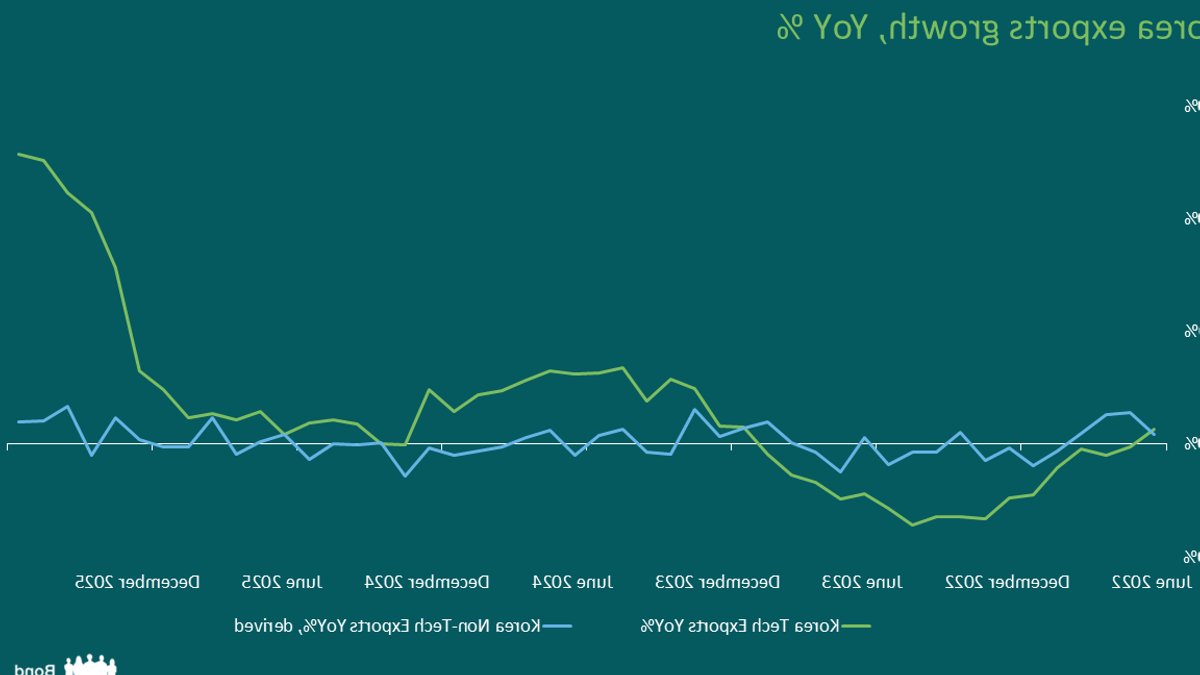
Record semiconductor exports lift the macro picture
Strong demand for AI‑driven chips pushed the country’s current‑account surplus to a historic USD 123 billion, roughly 6.5% of GDP in 2025. Analysts expect a similar surplus this year as overseas chip orders stay robust.
Higher household incomes and wealth effects are projected to raise GDP growth to about 2.7% in 2026, a pace above the nation’s long‑term trend. The fiscal gap is set to narrow from 3.9% of GDP in 2025 to 3.1% in 2026, with further improvement foreseen by 2027.
Currency weakness persists despite the surplus
In the past twelve months the Korean currency has fallen 12.6% against the U.S. dollar, reaching levels not seen since 2009. The depreciation runs counter to the country’s stronger external position.
Capital flows have outweighed the positive fundamentals. Roughly USD 100 billion left Korean equities, driven mainly by sales of shares in Samsung Electronics and SK Hynix, which together make up half of the market’s capitalisation.
Domestic investors kept sending money abroad while foreign holders trimmed positions for profit‑taking and portfolio rebalancing. Exporters converted only a modest share of their dollar earnings into the local unit, and net foreign‑direct investment stayed negative.
Policy makers have responded with verbal intervention, expanded FX‑hedging options for the National Pension Service, and tighter oversight of banks’ currency trading. Exporters’ dollar‑to‑won conversion rose to 18.6% in March, the highest rate in almost two years.
Current‑account data show a surplus of about USD 102.7 billion for January‑April 2026, and the central bank projects a full‑year surplus near USD 250 billion. While the historic link between the real effective exchange rate and the surplus has weakened, the continued external strength should slowly close the gap.
Looking ahead, corporate inflows could provide a modest boost. Proceeds from SK Hynix’s upcoming U.S. ADR listing are expected to be partly turned into the local currency for domestic chip projects, and seasonal tax prepayments may add demand, though the exact size is uncertain.
Bond market under pressure
Local‑currency government bonds have been the poorest‑performing Asian market since mid‑2025, with the iBoxx ALBI Korea Index down 10% in local terms. The sell‑off reflects several factors.
Investors have priced out policy easing as household debt rose, the housing market recovered, and a weaker currency complicated the inflation outlook. Early 2026 inflation worries—first sparked by geopolitical tensions and then reinforced by stronger domestic growth—led markets to expect a higher policy‑rate path.
The central bank now forecasts headline inflation of 2.7% in 2026, well below the peak seen during the 2022 energy crisis. A recent oil‑price decline after the U.S.–Iran ceasefire further supports the view that inflation may peak around August.
Despite lower price pressures, bond yields have already returned to levels seen in 2022. The market is pricing in four rate hikes this cycle, while the bank’s own projections suggest only three. Inclusion of Korean bonds in the FTSE World Government Bond Index could attract about USD 52 billion of passive inflows over eight months starting April 2026.
Excessively tight financial conditions could become a source of instability, limiting how far rates can rise. The balance of risks is beginning to look more asymmetric, with inflation and stability concerns still present but much of the tightening already reflected in prices.
Outlook and market positioning
Analysts argue that the current pricing of the currency and bonds is overly pessimistic. The sell‑off appears excessive given the lower inflation outlook and the country’s solid external buffers.
As capital‑flow pressures ease, the local unit and the bond market may start to align more closely with the underlying fundamentals. The government’s mega‑investment projects, together with ongoing semiconductor expansion by the two major chipmakers, should provide structural support.
In the near term, uncertainty remains around further equity‑related outflows. Yet the widening gap between market pricing and macro data seems hard to sustain. If the flow trends moderate, the currency and bond yields could gradually reprice toward stronger fundamentals.
For investors, the shift suggests a more constructive stance on duration within Asian local‑currency bond portfolios, favoring the mid‑curve while scouting selective opportunities at the ultra‑long end.
The central bank’s latest Financial Stability Report highlighted rising household debt and vulnerabilities among small‑business borrowers, but an overly restrictive stance could backfire, limiting the scope for additional rate hikes.
In sum, the macro backdrop has improved markedly, yet market pricing has lagged. Continued external surpluses, policy adjustments, and corporate currency inflows may eventually bring the currency and bond markets back in line with the country’s stronger fundamentals.

Bond Vigilantes World Cup Knockout Model


